
Bay County Emergency Management Issues Urgent Hurricane Kit Reminder as Tropical Storm Bertha Moves Through Gulf |
Officials urge residents to prepare for at least the first 72 hours after a storm, while Florida’s new year-round tax exemptions make many hurricane supplies more affordable. |
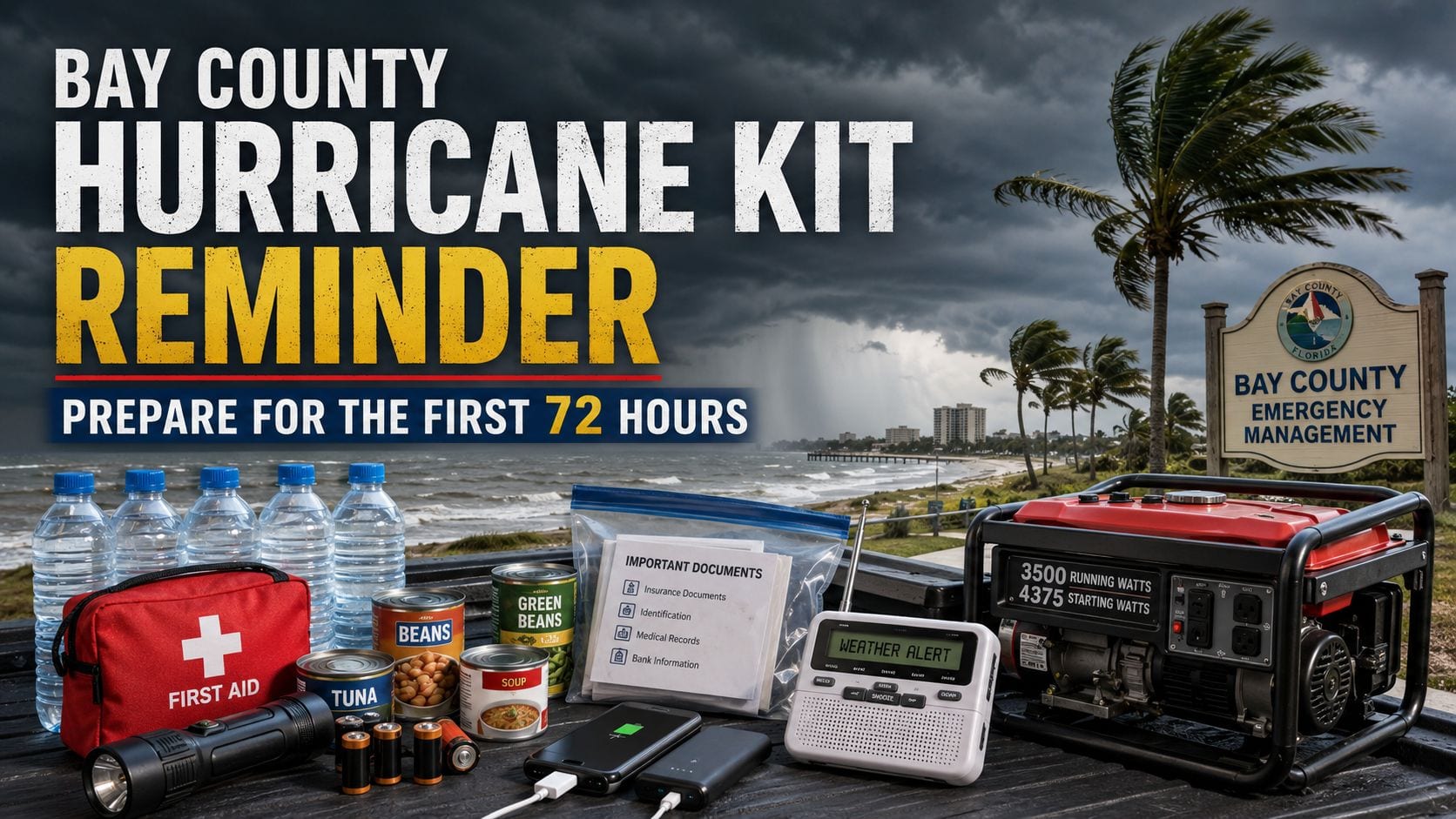
As Tropical Storm Bertha moves across the northern Gulf of America, Bay County Emergency Management is urging residents to use the storm as a reminder to review evacuation plans and finish assembling their hurricane supply kits.
The message from local officials is simple: do not wait until a hurricane is headed directly toward Bay County before beginning preparations.
Tropical Storm Bertha developed in the Gulf south of the Florida Panhandle and strengthened to maximum sustained winds near 60 mph by Tuesday, July 21. Although the storm’s projected path was shifting west toward Louisiana, Bertha was still expected to produce heavy rain, gusty winds, rough surf, dangerous rip currents and possible coastal flooding across portions of the northern Gulf Coast.
For Bay County residents, the storm serves as an early-season warning that tropical systems can develop quickly and that their effects may extend far beyond the forecast center line.
“The First 72 Is on You”
Bay County Emergency Management Deputy Chief Russell Beaty said households should be prepared to take care of themselves during the critical first three days following a major storm.
“The first 72 is on you,” Beaty told WJHG. “There could be delays in emergency services, power restoration, food and water after a storm.”
Emergency officials recommend that every household have enough food, drinking water, prescription medication and other essential supplies to last at least 72 hours. Residents should also review their family communication plan, know their evacuation zone and keep important documents in a secure, waterproof container.
While 72 hours is considered the immediate minimum, the Florida Division of Emergency Management recommends building a more complete kit capable of supporting each household member for at least seven days. That longer supply window can be especially important following a major hurricane, when roads may be blocked, stores may remain closed and utilities could be unavailable for an extended period. What Belongs in a Hurricane Kit?
A basic disaster supply kit should include:
Residents should also make sure vehicles are fueled, outdoor property is secured and generators are tested before severe weather arrives.
Generators must always be operated outdoors and far away from doors, windows and vents. They should never be used inside a home, garage or enclosed porch because of the risk of deadly carbon monoxide poisoning.
Read Article on Bay County Hurricane Preparedness Week:
Also see Article on Panama City & Bay County Emergency Guide
See Tropical Depression Two Article
Many Hurricane Supplies Are Now Tax-Free Year-Round
Preparing a hurricane kit may now cost Floridians a little less.
Beginning August 1, 2025, Florida established permanent sales-tax exemptions for several categories of disaster-preparedness supplies. Qualifying products include household batteries, fire extinguishers, smoke detectors, carbon monoxide alarms and portable generators capable of producing 10,000 running watts or less.
Other qualifying items include life jackets, insect repellent, sunscreen, waterproof tarps, ground-anchor systems, tie-down kits and portable gas or diesel containers holding five gallons or less. Local discretionary sales taxes may still apply in some cases.
Unlike Florida’s previous limited disaster-preparedness sales-tax holidays, these exemptions are available throughout the year. That allows families to spread purchases across several weeks or months instead of trying to buy everything immediately before a storm.
Beaty recommended purchasing a few extra items during regular grocery trips and setting them aside. Gradually building a kit can make preparation more manageable while helping families avoid crowded stores and supply shortages when a storm approaches.
Know Your Zone and Stay Connected
Bay County has four storm-surge evacuation zones: A, B, C and D. Zone A includes areas closest to the water and would typically be considered first if evacuations become necessary. Residents should know their zone before an evacuation order is issued.
Emergency Management also encourages residents to register for AlertBay, the county’s emergency notification system. Alerts can provide potentially lifesaving information concerning severe weather, evacuations, road closures and other public emergencies.
Tropical Storm Bertha may not become a direct hurricane strike on Bay County, but officials say that is not a reason to become complacent. Each tropical system provides another opportunity to check supplies, update plans and make sure every member of the household knows what to do.
The best time to prepare is before the forecast cone turns toward home. |
📺 Panama City Spotlight YouTube https://www.youtube.com/@PanamaCitySpotlight
🎬 YouTube Playlists https://www.youtube.com/@PanamaCitySpotlight/playlists
👍 Like and Follow us on Facebook: https://www.facebook.com/PanamaCitySpotlight
👥 Join our Facebook Group: https://www.facebook.com/groups/PanamaCitySpotlight
🍴 Panhandle Fork - Like and Follow us on Facebook: https://www.facebook.com/PanhandleFork
🍴 Panhandle Fork - Join our Facebook Group: |
25 Comments
Join the conversation
Man, I wish prices in stores wouldn’t jump before storms hit, even if tax is off.
I appreciate the advice to prepare gradually. Panic shopping always leaves shelves empty.
Portable chargers saved my phone more than once when power went out. Highly recommend.
Glad Bertha missed us but we shouldn’t wait for a close call next time.
Are new residents getting these storm prep tips mailed out or just online?
Insect repellent is a must. After a storm the mosquitoes are insane.
My neighbor’s generator set off the CO alarm last storm. Keep those OUTSIDE y’all!
Seven day kits seem like a lot but after a storm, stores are empty. Worth it.
Does anyone know if surge zones have changed since last year’s flood?
Glad the article mentioned keeping documents waterproof! Lost so much paperwork in the flood.
People are still complacent until the last minute. Even with all these warnings!
Is there any help for seniors who might not be able to get their own supplies?
I wish more folks would secure their outdoor furniture before storms. Busted windows last time…
AlertBay actually works pretty well. Got a tornado warning last time before TV had it.
Wasn’t prepared at all last year. Going to start my kit now. Thanks for list.
I have two dogs & always forget their meds when prepping. Pet supplies are important!
Do these sales tax exemptions include propane tanks or just the small containers?
Good idea to keep cash on hand, the ATMs go down quick in bad weather.
Got caught in long lines before last storm. Buying a little at a time now is way less stressful.
The generator safety tips could save lives. Folks don’t realize CO is so dangerous.
First 72 is on you—hard lesson I learned after Michael. Stock up folks.
We finally bought a weather radio last year after the power outages. Worth every penny.
Glad Bertha isn’t heading directly at us, but these storms can always surprise you.
I always forget about checking my evacuation zone until it’s the last minute. Thanks for the reminder!
The tax-free supplies is nice, didn’t realize it was year-round now.